What is AHD Manifest Finder & How to Use a Steam Manifest Finder
A plain-English guide to Steam manifest files, manifest finders, and how to get your game running with SteamTools in under five minutes.

Table of Contents
- What Does 'AHD Manifest Finder' Actually Mean?
- Steam Manifest Files Explained
- Key Concepts: AppID, DepotID, ManifestID
- What Is a Steam Manifest Finder?
- Manifest Finder Tools Compared
- Step-by-Step: How to Use a Manifest Finder
- Understanding Lua Scripts for SteamTools
- Troubleshooting Common Issues
- FAQ
If you have ever typed 'AHD manifest finder' into a search engine, you are not alone. Thousands of people search for this phrase every month — and most of them are trying to solve the same problem: they want to find and download the right Steam manifest files so they can use SteamTools to manage their games.
Here is the honest answer: 'AHD manifest finder' is not the name of one specific, official tool. It is a search term that has evolved organically in the gaming community, often typed by non-native English speakers who are looking for a manifest finder for Steam — sometimes with a typo ('ahd' instead of 'and'), sometimes as shorthand for a tool they heard about in a Discord server or forum thread.
Whatever brought you here, this guide will give you everything you need. We will explain what Steam manifest files actually are, what a manifest finder does, and walk you through using one step by step.
What Does 'AHD Manifest Finder' Actually Mean?
Let's clear this up right away. When people search for 'AHD manifest finder' or 'ahd.manifest finder', they are almost always looking for one of two things:
- A typo for 'and manifest finder': The most common explanation. On many keyboard layouts, 'h' sits right next to 'n', making 'ahd' a natural slip for 'and'. So 'ahd manifest finder' is simply 'and manifest finder' — a tool that finds manifest files.
- A community shorthand: In some gaming communities, particularly those where English is a second language, 'AHD' circulates as an abbreviation for a specific manifest-related workflow or tool shared in private Discord servers or Telegram groups.
Either way, the underlying need is the same: users want a reliable way to locate, download, and use Steam manifest files alongside Lua scripts for SteamTools. That is exactly what a Steam manifest finder does — and that is what the rest of this guide covers.
Bottom Line
Whether you searched for 'AHD manifest finder', 'manifest finder steam', or 'manifest and lua generator', you are looking for the same thing: a tool that finds and packages Steam manifest files for use with SteamTools. Read on.
Steam Manifest Files Explained
Before diving into tools, it helps to understand what a manifest file actually is. Steam's content delivery network (CDN) is one of the most sophisticated digital distribution systems ever built. At its core, it relies on a file format called a manifest.
A Steam manifest file (`.manifest`) is a structured data file that describes the complete contents of a game depot. Think of it as a detailed inventory list for a warehouse: it tells Steam exactly which files exist, where they live, how large they are, and how to verify their integrity.
What a Manifest File Contains
- File paths and directory structure for every game file
- File sizes and SHA-1 checksums for integrity verification
- Depot ID and content version identifiers
- Chunk metadata for efficient delta downloads
- Download priorities and dependency information
- Encryption flags and update scheduling data
According to SteamDB's technical documentation, Steam's download system uses these manifests to calculate exactly which chunks of data need to be downloaded or updated — making game updates far more efficient than re-downloading entire files. SteamDB technical blog.
For SteamTools users, manifest files serve a different but related purpose: they provide the metadata SteamTools needs to recognize and manage a game's depot, enabling features like offline play, DLC management, and game unlocking workflows.
Key Concepts: AppID, DepotID, and ManifestID
To use any manifest finder effectively, you need to understand three core identifiers. These are the building blocks of Steam's entire content system.
Steam Manifest Key Concepts at a Glance
| Concept | What It Is | Example | Why It Matters for Manifest Finders |
|---|---|---|---|
| AppID | Unique game identifier | 730 (CS2) | Starting point for every manifest lookup |
| DepotID | File group within a game | 731 (CS2 content depot) | Determines which files are included |
| ManifestID | Specific version snapshot | 23442636256031311 | Targets exact game version |
| BuildID | Overall build version | Visible on SteamDB Builds tab | Tracks which update a manifest belongs to |
| Decryption Key | Cryptographic access key | Stored in .vdf files | Required to actually use the manifest content |
AppID
The unique numerical identifier for every game or application on Steam.
Example: CS2 = 730, GTA V = 271590, Cyberpunk 2077 = 1091500
Every manifest finder starts here. You enter an AppID, and the tool looks up the associated depots and manifests.
DepotID
A subdivision within a game that groups related files together.
Example: A game might have separate depots for the base game, each language pack, and each DLC.
One AppID can have multiple DepotIDs. Manifest finders retrieve manifests for all relevant depots automatically.
ManifestID
A unique identifier for a specific version of a depot's file set.
Example: 23442636256031311 — a long number that pinpoints an exact game version.
Different ManifestIDs represent different game versions. This is how you can target a specific build of a game.
BuildID
An identifier for the overall build version of a game across all its depots.
Example: Visible on SteamDB under a game's 'Builds' tab.
Useful for tracking which update a manifest corresponds to.
Decryption Key
A cryptographic key required to decrypt and access the actual game content within a depot.
Example: Stored in .vdf (Valve Data Format) key files.
Without the correct decryption key, even a valid manifest file cannot be used to access game content. Quality manifest finders include these key files in their download packages.
What Is a Steam Manifest Finder?
A Steam manifest finder is a web-based or desktop tool that automates the process of locating, retrieving, and packaging Steam manifest files for a given AppID. Instead of manually navigating GitHub repositories, cross-referencing DepotIDs, and hunting for matching Lua scripts, a manifest finder does all of that in seconds.
The best manifest finders pull their data from community-maintained repositories like ManifestHub — a large, actively updated library of Steam depot manifests hosted on GitHub. When you enter an AppID, the tool queries this database, assembles the relevant files, and delivers them as a ready-to-use ZIP package.
What a Good Manifest Finder Delivers
| File Type | Extension | Purpose | Required? |
|---|---|---|---|
| Manifest File | .manifest | Depot file list, checksums, structure | Yes |
| Lua Script | .lua | SteamTools game configuration | Yes |
| JSON Config | .json | Game metadata and depot mappings | Recommended |
| Key File | .vdf | Depot decryption keys | Yes (for content access) |
The entire workflow — from entering an AppID to having a working ZIP file — typically takes under 30 seconds with a modern manifest finder.
Steam Manifest Finder Tools Compared
The manifest finder ecosystem has grown significantly over the past few years. Here is an honest comparison of the main options available as of 2026.
Note: Tool availability and features change frequently in this space. Always verify a tool is still active before relying on it.
| Tool | Source | File Types | Ease of Use | Update Frequency | Best For |
|---|---|---|---|---|---|
|
manifestlua.blog
This site |
ManifestHub (GitHub) | .manifest, .lua, .json, .vdf | ⭐⭐⭐⭐⭐ Very Easy | Continuous | All users — browser-based, no install |
|
ManifestHub (GitHub)
Raw repository |
Community-maintained | .manifest, .lua, .vdf | ⭐⭐⭐ Moderate | Continuous | Advanced users comfortable with GitHub |
|
SteamDB
steamdb.info |
Valve's Steam network | Manifest metadata only | ⭐⭐⭐⭐ Easy | Real-time | Looking up AppIDs and ManifestIDs |
|
Manifest Dumper
Desktop GUI tool |
Direct Steam extraction | .manifest, .vdf | ⭐⭐ Requires setup | Manual | Users who own the game and want to extract their own manifests |
For deeper technical background on how Steam's AppManifest system works, the PCGamingWiki Steam page is an excellent community-maintained reference covering everything from file locations to troubleshooting.
Step-by-Step: How to Use a Steam Manifest Finder
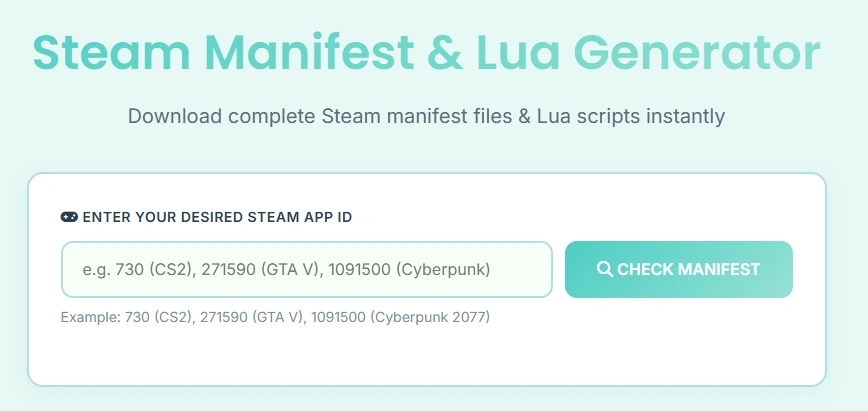
Using a manifest finder is straightforward once you know the workflow. Here is the complete process from start to finish.
-
Find Your Game's AppID
Every Steam game has a unique AppID. The easiest ways to find it: check the Steam store URL (store.steampowered.com/app/APPID/), use our AppID Finder tool, or look it up on SteamDB. Common examples: CS2 is 730, Dota 2 is 570, GTA V is 271590.
-
Enter the AppID into the Manifest Finder
Go to the manifest finder tool and paste your AppID into the search field. Click the check or generate button. The tool will query the ManifestHub database and verify whether manifest files exist for that game.
-
Review the Terminal Output
A good manifest finder shows you a live terminal-style output as it works — connecting to the database, locating manifest files, verifying Lua scripts, and preparing the download. This transparency lets you confirm the tool found what you need.
-
Download the ZIP Package
Once the tool confirms it found the manifest, click the download button. You will receive a ZIP file containing all the relevant .manifest, .lua, .json, and .vdf files for that game.
-
Extract and Import into SteamTools
Extract the ZIP to a folder. Open SteamTools. Drag the .lua file onto the SteamTools floating window. Restart Steam. The game should now be recognized by SteamTools with full functionality.
Pro Tip
If you are unsure which AppID to use for a game with multiple editions (Standard, Deluxe, GOTY), check SteamDB first. Each edition has its own AppID, and using the wrong one will result in a 'manifest not found' error.
Not sure what AppID your game uses? Use our AppID Finder tool to search by game name and get the right ID instantly.
Understanding Lua Scripts for SteamTools
Lua is a lightweight, embeddable scripting language that has been a staple of game development for decades. In the context of SteamTools, Lua scripts serve as the bridge between the manifest data and the actual game management functionality.
When you drag a .lua file onto SteamTools, you are essentially giving SteamTools a set of instructions: which AppID this game belongs to, which depots are involved, what DLCs are available, and how to handle the game's authentication flow.
What a SteamTools Lua Script Does
- Defines the AppID and associated depot mappings
- Lists available DLCs and their activation status
- Configures offline play permissions for the title
- Sets up achievement and cloud save compatibility
- Handles multiplayer and Remote Play session parameters
The Lua scripts included in a manifest finder download are pre-configured and tested for each specific game. You do not need to write or edit them — just drag and drop.
A Note on Script Quality
Not all Lua scripts are created equal. Scripts from well-maintained sources like ManifestHub are regularly updated as games receive patches. If a game update breaks your SteamTools setup, the fix is usually as simple as downloading a fresh manifest package with the updated Lua script.
Troubleshooting Common Manifest Finder Issues
Even with a reliable tool, you will occasionally run into snags. Here are the most common issues and how to resolve them.
| Problem | Likely Cause | Solution |
|---|---|---|
| Manifest Not Found | The game has not been added to the ManifestHub database yet. | This is most common with very new releases (within the first week of launch) or obscure regional titles. Check back in a few days — the community database updates frequently. You can also check the ManifestHub GitHub repository directly to see if the game is listed. |
| Download Fails or ZIP is Empty | Network interruption or temporary server issue. | Refresh the page and try again. If the issue persists, try a different browser or disable browser extensions that might interfere with downloads. |
| SteamTools Does Not Recognize the Lua File | Wrong AppID used, or the Lua script is outdated. | Double-check the AppID on SteamDB. If the game received a recent update, download a fresh manifest package — the Lua script may need to be updated to match the new build. |
| Game Shows as 'Not Owned' After Import | Missing or incorrect decryption key (.vdf file). | Ensure the full ZIP package was extracted correctly and all files (including .vdf key files) are present. Re-download the package if any files are missing. |
For a full visual walkthrough of the manifest download process, visit our How It Works page .
Frequently Asked Questions
About the Author
Sophie Laurent
Tech Writer & PC Gaming Enthusiast
Sophie Laurent is a tech writer and lifelong PC gamer who has spent years demystifying Steam internals for everyday players. She covers game file management, modding workflows, and SteamTools integrations. When she is not writing, she is probably deep in a 100-hour RPG.
References & Further Reading
- SteamDB — Taking a look at Steam's download and preload system (steamdb.info/blog/steam-download-system/)
- PCGamingWiki — Steam AppManifest database documentation (pcgamingwiki.com)
- ManifestHub — Community Steam depot manifest library (github.com/SteamAutoCracks/ManifestHub)
- Dota 2 Classic — Steam AppID, DepotID, ManifestID explained (dota2classic.com/Download/Manual)
Last updated: March 28, 2026