DepotDownloader GitHub: 9 Checks Before You Download a Steam Depot
A practical guide to the open-source DepotDownloader workflow, including AppID, DepotID, ManifestID, branch access, account safety, and how it differs from a SteamTools manifest package.

DepotDownloader is transparent when you start from the GitHub project, verify the IDs, and keep downloads isolated from your live Steam library.
Table of Contents
DepotDownloader is an open-source command-line tool used to download Steam depot content when you know the right AppID, DepotID, and, when needed, ManifestID. People often find it through GitHub because the repository explains the project, releases, command syntax, and issue history in one place.
The tool is useful, but it is not a magic manifest button. A successful command still depends on account ownership, depot permissions, branch rules, encryption keys, and whether the manifest version is still available to your account. The safe workflow is to verify the target before you run anything and to download into a separate folder first.
This guide fills the gap between two common searches: users who want the DepotDownloader GitHub project, and users who actually want a SteamTools-ready manifest and Lua package. If you only need this site's ZIP package for SteamTools, start with the Manifest & Lua Generator. If you need a controlled depot download, use the checklist below.
Quick Answer: When Should You Use DepotDownloader?
Use DepotDownloader when you need explicit control over a Steam depot download: a specific depot, a specific manifest version, a branch, a destination folder, or a repeatable command you can review later. It is especially useful for build comparison, modding baselines, research, and cases where the Steam client console is too opaque.
Do not use DepotDownloader as a substitute for checking permissions. If your account does not own the app, lacks branch access, or cannot access encrypted depot content, changing command syntax will not fix the problem. Start with a verified app and depot, then decide whether the tool is appropriate.
| Need | Best fit | Why |
|---|---|---|
| I need a SteamTools Lua package | Manifest & Lua Generator | It bundles manifest, Lua, JSON, and key files for a SteamTools-style workflow. |
| I need to check package availability | Steam Manifest Finder | It answers whether this site has a package for an AppID before you download. |
| I need one depot or old depot version | DepotDownloader | It lets you target AppID, DepotID, ManifestID, branch, and output folder explicitly. |
| I only know the game name | AppID Finder | It reduces wrong edition, demo, soundtrack, and DLC AppID mistakes. |
What DepotDownloader Is and What It Is Not
DepotDownloader is a separate command-line downloader for Steam depot content. The GitHub project is the best starting point because you can review the README, releases, source history, and issues before trusting a binary or command example from somewhere else.
It is not an official Steam page, not a SteamTools package generator, and not a bypass for account or branch restrictions. It talks to Steam content systems using the details you provide. If those details are wrong, the result may be incomplete, rejected, or simply not the depot you expected.
Open project
Use the repository and release notes as the primary source for syntax, binaries, and changes.
Command-line tool
You plan options before running the command, including app, depot, manifest, branch, and folder.
Permission-bound
Ownership, branch passwords, and encrypted depots still matter.
Depot output
The output is depot files, not automatically a complete SteamTools Lua package.
Practical rule
If your goal is one controlled depot download, DepotDownloader may fit. If your goal is a ready SteamTools package, use the generator or finder first.
GitHub Checks Before You Download Anything
Because many search results mirror popular tool names, start from the original project page or a trusted release link. Do not download a random archive just because the title includes DepotDownloader. A transparent release should make the version, file list, update date, and project source clear.
Check the release date against the issue you are solving. If a command from an old forum post fails, the project may have changed syntax, Steam may have changed access behavior, or the depot may require a branch option that the example never mentioned.
| Check | What to inspect | Why it matters |
|---|---|---|
| Repository source | Project owner, README, releases, and issue history | Avoids repackaged or renamed downloads. |
| Release freshness | Latest release date and recent commits | Old binaries may not match current Steam behavior. |
| Binary source | Release asset from the project, not an ad mirror | Reduces wrapper and malware risk. |
| Command examples | README syntax before blog/forum snippets | Examples online often omit branch or manifest options. |
| No forced installer | Avoid password archives, browser extensions, and unrelated EXE wrappers | Depot tools should not require unrelated software layers. |
Plan the IDs Before You Plan the Command
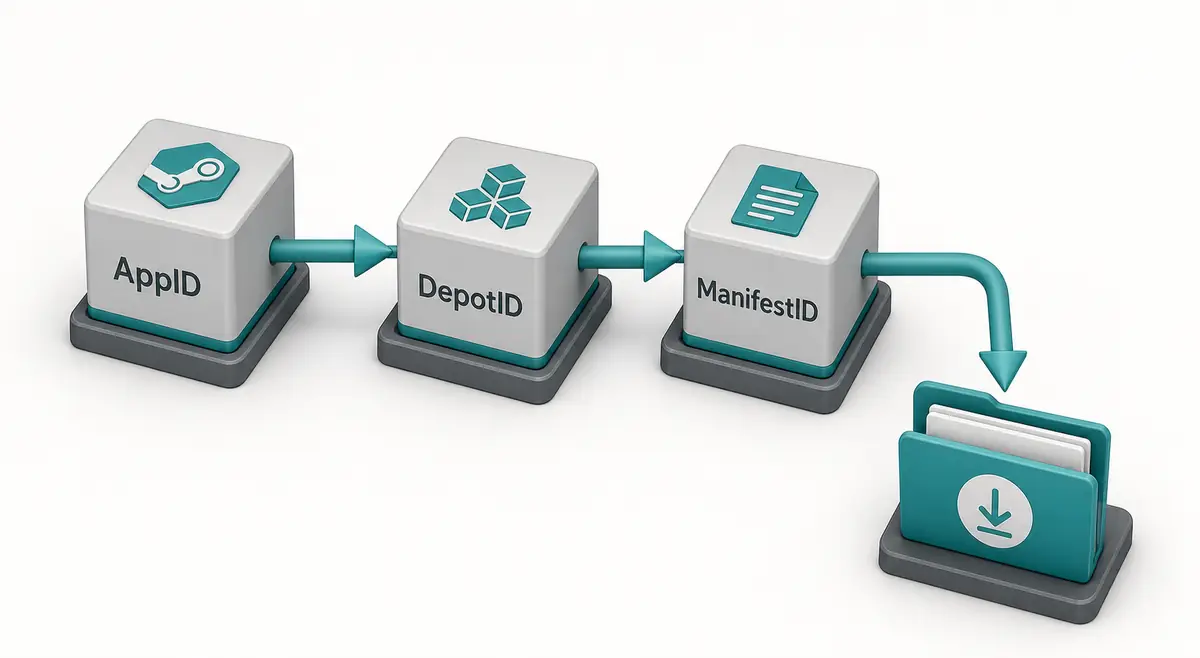
The command is only as good as the IDs. AppID identifies the app. DepotID identifies a content group inside that app. ManifestID identifies one version snapshot of that depot. Branch or beta settings may further limit what the account can reach.
Write the IDs down before running a command. Include app title, AppID, depot name, DepotID, ManifestID, branch name, expected platform or language, and output folder. This simple note prevents the most common mistake: mixing a manifest from one depot with an AppID or Lua package from another source.
-
Confirm the AppID from the store URL, SteamDB, or the AppID Finder.
Do not guess from a game title because demos, DLC, test apps, and soundtracks can have separate AppIDs.
-
Choose the DepotID that matches your target files.
A Windows depot, language depot, DLC depot, or shared asset depot may contain only part of the game.
-
Use ManifestID only when you need a specific version.
For current files, a manifest parameter may be unnecessary. For an older build, the ManifestID must belong to that selected depot.
-
Set a separate output directory.
Never point a first test download straight at your live Steam library.
-
Keep the command and notes together.
Save the IDs and command in a text file so you can audit what happened later.
Account, Branch, and Folder Safety Checks
DepotDownloader may require account login depending on the depot and app. Treat that as a security decision. Use the official project documentation, avoid third-party wrappers that ask for credentials, and understand whether the depot needs ownership, branch access, a password, or encrypted depot keys.
The safest destination is a clean folder outside your active Steam library. After the download, compare file structure, timestamps, and expected content before copying anything into a working install. A partial depot can be useful for research but harmful if you overwrite a live game with it.

| Risk | Typical cause | Safer habit |
|---|---|---|
| Login confusion | A copied command does not explain account requirements | Read the current README and avoid credential prompts from mirrors. |
| Branch rejection | The depot belongs to a beta or private branch | Confirm branch name, password requirements, and ownership first. |
| Encrypted content | Depot needs keys not available to the account | Do not assume every depot is downloadable just because a manifest ID exists. |
| Broken install | Files are downloaded into the active game folder | Use a separate folder and compare before replacing anything. |
| Incomplete game | Only one depot was downloaded | Review language, DLC, platform, and shared depots before expecting a full install. |
DepotDownloader vs SteamTools Manifest Packages
A DepotDownloader result is usually the downloaded content from a depot. A SteamTools manifest package is a different bundle: manifest files, Lua scripts, JSON metadata, and sometimes VDF or key files that describe how a package should be handed to SteamTools. The two workflows can overlap, but they are not the same deliverable.
That distinction matters for search intent. Someone searching DepotDownloader GitHub usually wants a tool, syntax, releases, or a way to download depot files. Someone searching manifest and Lua generator usually wants a package for SteamTools. Use the right page for the job instead of forcing one workflow to do everything.
| Workflow | Output | Use when |
|---|---|---|
| DepotDownloader | Downloaded depot content in a folder | You need one depot, one manifest version, a branch-aware download, or repeatable CLI logs. |
| Steam console download_depot | Depot content from the Steam client | You need a quick manual download and understand the IDs. |
| Manifest & Lua Generator | ZIP package with manifest, Lua, JSON, and related files | You already know the AppID and want a SteamTools-style package. |
| Steam Manifest Finder | Availability check by AppID | You want to know whether a package exists before downloading. |
| SteamDB Manifest ID Guide | ID explanation and verification steps | You are still sorting out AppID, DepotID, ManifestID, or build history. |
Troubleshooting: What the Common Failures Usually Mean
When DepotDownloader fails, resist the urge to paste a new command from a random thread. Most failures are predictable: the account lacks access, the wrong depot was selected, the manifest ID does not belong to that depot, or an old example uses outdated syntax.
If the download succeeds but the result looks incomplete, that may be normal. Many Steam apps split files across multiple depots. A language depot, DLC depot, redistributable depot, or shared content depot may be separate from the base game depot.
| Symptom | Likely cause | First check |
|---|---|---|
| Manifest is rejected | ManifestID does not match the selected DepotID | Return to the depot history and copy the matching version. |
| Login or access error | Ownership, branch, or encrypted depot rules block access | Confirm account access and branch requirements. |
| Only some files download | You targeted one depot from a multi-depot app | Review platform, language, DLC, and shared depots. |
| Command example fails | Syntax changed or example omitted required options | Check the current GitHub README and release notes. |
| SteamTools import still fails | Downloaded content is not a Lua manifest package | Use the Manifest & Lua Generator or verify package files separately. |
Debugging order
Check ID match first, account and branch access second, syntax third, and destination folder last. Random command swapping usually hides the real mismatch.
FAQ
References
- DepotDownloader on GitHub - Primary project page for releases, documentation, and issue history.
- SteamDB - Useful for checking AppID, depot, branch, build, and manifest context before planning a command.
- Steamworks Depots documentation - Official Valve documentation explaining how Steam depots are organized for applications.
Last updated: July 1, 2026